


Split the line by medium before you write the specification. LPR applies to electrolyte environments only, so dry gas and non-conductive crude service are covered by coupons or ER probes. Everything else in the datasheet – pressure class, mounting form, data output – comes after that first line.
- Electrolyte service (produced water, wet systems, injection water) can use all three. The HS5000 LPR logger measures 4 x 10^-4 to 10 mm/a with a 1 cm2 electrode, at +/-0.2% F.S. and 17 bit resolution.
- Non-electrolyte service (dry gas, crude) uses a coupon or an EMT-EP100 ER probe rated below 45 MPa and -200 to 260 C, with an optional 260-450 C version.
- Data handover is a separate line item: RS-485 on HS5000, LORA and 4G-5G on HS5000WX, or internal storage plus Bluetooth download on HS5000JL.
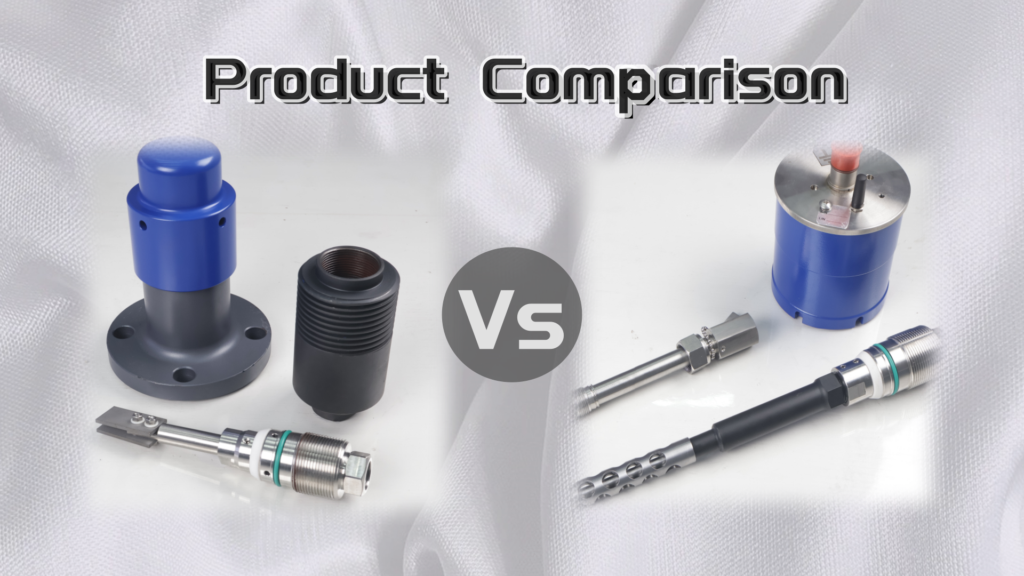
Why the medium decides the method
Electrochemical measurement needs an ionic path, and dry hydrocarbons do not provide one.
LPR derives a corrosion rate from polarisation resistance at the electrode surface. Without a conducting electrolyte the measurement has no physical basis. EMT’s LPR documentation states the restriction directly: online, real-time monitoring in electrolyte environments inside metal piping. This is not a matter of reduced accuracy. The method simply does not apply.
Coupons and ER probes measure metal loss directly – by weighing or by resistance change – so they work across conducting and non-conducting services alike. That is why the first line of a monitoring specification should describe the medium and its water content, not the preferred instrument.
Method availability by medium
Use the medium row to fix the method, then open the datasheet.
The wet gas row is deliberately conditional. EMT’s documentation gives an electrolyte requirement but no conductivity threshold, so the project team should confirm the phase at the electrode rather than assume a value. Where the medium changes along the route, write one specification line per section.
Table 1. Method availability by process medium
| Medium | Coupon | ER probe | LPR | Deciding condition |
| Dry gas transmission | Yes | Yes | No | No electrolyte path for polarisation resistance |
| Crude oil, low water cut | Yes | Yes | No | Non-conductive continuous phase |
| Produced water / brine | Yes | Yes | Yes | Conducting electrolyte present |
| Wet gas with condensate | Yes | Yes | Confirm | Depends on a continuous conductive phase at the electrode |
| Injection water | Yes | Yes | Yes | Conducting electrolyte; suited to event-level monitoring |
Pressure, temperature and enclosure checks
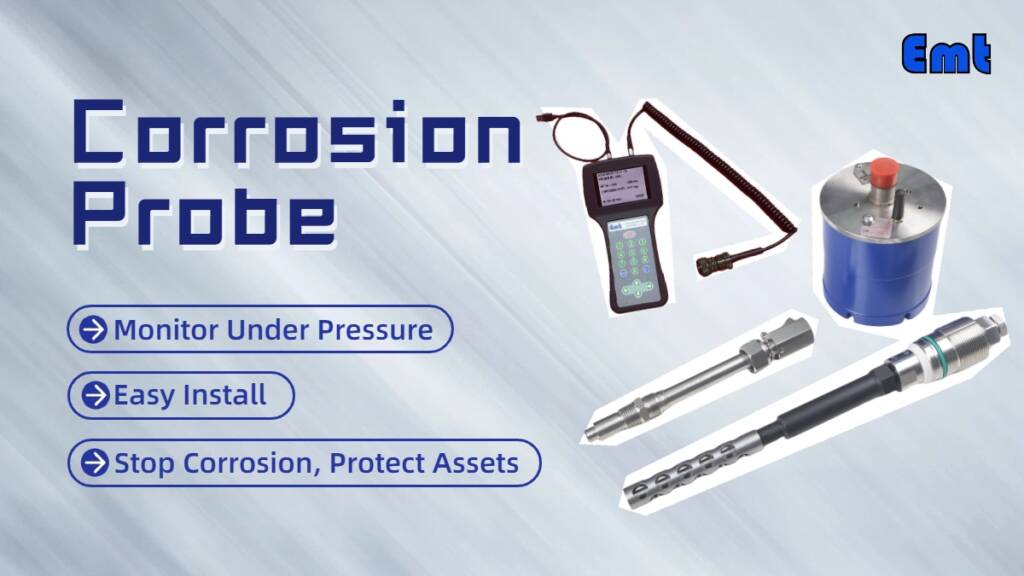
Specify the mounting form, not just the pressure number.
One value is intentionally absent. EMT’s LPR documentation carries two different low-pressure retrievable values in different sections, so this article publishes neither. Ask for the current controlled specification before adding a low-pressure LPR line to a tender document.
Table 2. Documented values to state on a specification sheet
| Check item | What to state in the spec | EMT documented value |
| ER probe pressure | Rated pressure of the retrievable probe | Below 45 MPa (EMT-EP100) |
| Coupon assembly pressure | Operating pressure of the hydraulic assembly | 0-68.9 MPa |
| LPR high-pressure probe | Pressure range of the retrievable form | 25-41.3 MPa, double-seal tool recovery |
| Probe temperature | Rated temperature plus optional version | ER: -200 to 260 C, optional 260-450 C; LPR probe: 0-260 C |
| Logger electronics temperature | Operating and storage range of the electronics | -40 to 70 C operating; -40 to 85 C storage |
| Supply and consumption | DC supply and wired power draw | 7-36 VDC; 5.4 W wired version |
| Enclosure and hazardous area | Ingress and Ex marking | IP66; EX-d IIC T4 Gb; 500 g |
| Flange and opening | Flange standard and nozzle size | HG/T 20615-2009 CL150 DN50 RF; HG/T 20592-2009 DN50 PN25 RF; DN40 or DN50 opening |
Data output and model codes
The logger model is chosen by how the data leaves the site.
EMT lists four output paths for the HS5000 series: RS-485 wired signal to a host computer (HS5000); LORA and 4G-5G wireless upload to a corrosion platform (HS5000WX); and internal storage with Bluetooth download to a handheld unit or local computer (HS5000JL). One measurement cycle can be set from 10 minutes to 24 hours.
Probe codes separate the mounting form: LPR5000 gland-packed seal, LPR6000 flange-fixed integral weld, LPR7000 high-pressure carrier, LPR8000 ambient threaded spool. Probe forms are SS (retractable), GD (fixed insertion) and RD (cable-soft); electrode forms include 3Z three-finger, 3P three-plate, 3H three-ring and XD custom. A worked order code and the full electrical parameter table belong in the public technical note, not in a specification summary.
The HS5000 series is factory calibrated before dispatch and configured by instrument ID, so no field calibration is required. Put that in the commissioning section of the specification – it changes the site work scope.
Writing the specification line
Six items, in this order, produce a datasheet a vendor can actually quote against.
- Medium and water content for each monitored section, including any phase change along the route.
- Method per section: coupon or ER probe for non-electrolyte service; all three available for electrolyte service.
- Pressure class and mounting form together, including whether retrieval under pressure is required.
- Temperature for the probe and for the logger electronics as two separate lines.
- Measurement cycle, data output path and the corresponding HS5000 model.
- Enclosure, hazardous-area marking, flange standard and opening size.
Frequently asked questions
Can LPR be used on a dry gas transmission line?
No. EMT’s LPR documentation limits the technique to electrolyte environments in metal piping. Dry gas cannot support the polarisation resistance measurement. Specify a corrosion coupon or an EMT-EP100 ER probe, and reserve LPR for produced water, injection water and other conducting sections.
What does EMT’s LPR logger measure and how accurately?
The HS5000 series reports corrosion rate over 4 x 10^-4 to 10 mm/a with a 1 cm2 electrode, at +/-0.2% F.S. and 17 bit resolution, with a 25.6 mV B value. One measurement cycle can be set between 10 minutes and 24 hours. Units are calibrated at the factory and configured by instrument ID.
Which LPR models support wireless transmission?
HS5000WX handles LORA and 4G-5G wireless upload to a corrosion platform and needs a communication converter or wireless gateway. HS5000 is the RS-485 wired version; HS5000JL stores data internally for Bluetooth download to a handheld unit or local computer.
What is the pressure rating of the EMT-EP100 ER probe?
Below 45 MPa, over -200 to 260 C, with an optional 260-450 C version. Use the controlled product specification when preparing a tender. For higher line pressure, EMT’s hydraulic coupon and probe assembly is rated 0-68.9 MPa.
Do the logger electronics have the same temperature rating as the probe?
No. The HS5000 electronics operate from -40 to 70 C and store from -40 to 85 C, while an LPR probe can be specified to 260 C. Keep the two on separate specification lines; the electronics rating usually sets the mounting location.
Is EMT ASME certified?
Yes. Shenyang EMT Piping Technology Co., Ltd. holds ASME certification. Request the certificate details applicable to your tender from our team.
About EMT and certification
Shenyang EMT Piping Technology Co., Ltd. holds ASME certification. Contact our team for the certificate details relevant to your project.
Shenyang EMT Piping Technology Co., Ltd. designs and manufactures pipeline pigging, corrosion monitoring and pressure-access equipment for oil and gas service. Product figures in this article come from EMT’s own manuals and specification sheets; they are not third-party test results.
Sources and standards
Every specification in this article comes from EMT’s own product documentation: the Hydraulic Corrosion Coupon and Probe Manual (2025-01), the EMT-EP100 Electrical Resistance Probe specification and selection table, and the LPR corrosion monitoring manual with HS5000 logger and LPR5000-8000 probe specifications. These are manufacturer specifications, not third-party test results.
Standards referenced:
- ASTM G1, Standard Practice for Preparing, Cleaning, and Evaluating Corrosion Test Specimens (astm.org)
- ASTM G46, Standard Guide for Examination and Evaluation of Pitting Corrosion (astm.org)
- NACE SP0775, Preparation, Installation, Analysis, and Interpretation of Corrosion Coupons in Oilfield Operations (ampp.org)
- ASME B31.4, Pipeline Transportation Systems for Liquids and Slurries (asme.org)
- ASME B31.8, Gas Transmission and Distribution Piping Systems (asme.org)
- ASME B16.5, Pipe Flanges and Flanged Fittings (asme.org)
- ASME B16.34, Valves – Flanged, Threaded, and Welding End (asme.org)
- API RP 571, Damage Mechanisms Affecting Fixed Equipment in the Refining Industry (api.org)
- ISO 8044, Corrosion of metals and alloys – Vocabulary (iso.org)
- ISO 15156 / NACE MR0175, Materials for use in H2S-containing environments (iso.org, ampp.org)

